
Market Update · 16 min read
The 30-Year Fell to 7.24%. First Survey After the October Hold.
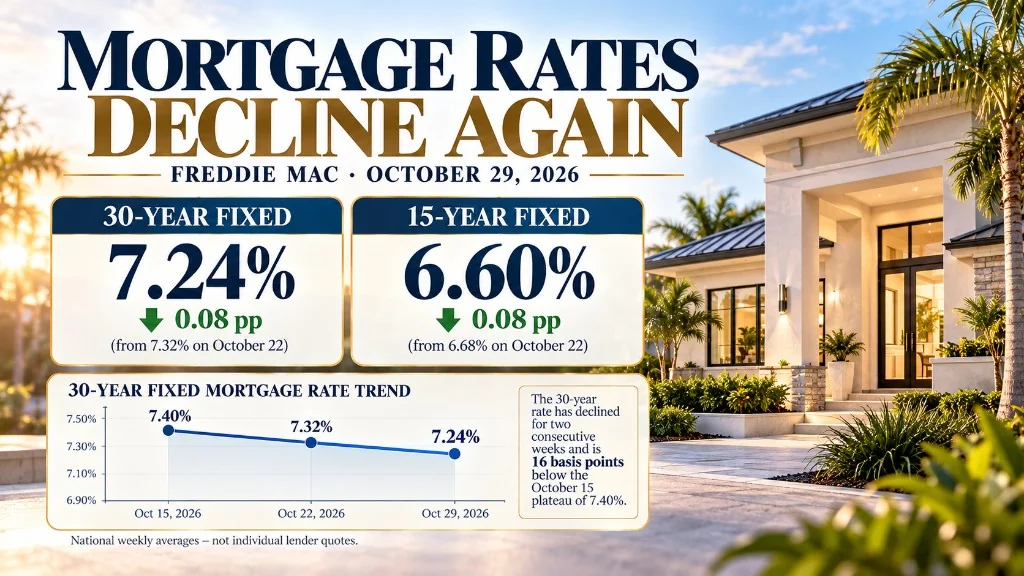
Freddie Mac's October 29, 2026 survey put the 30-year fixed at 7.24%, down from 7.32% the week before, and the 15-year fixed at 6.60%, down from 6.68%. A year ago the averages were 6.17% and 5.41%. On $300,000, principal and interest is $2,044.49 a month on the 30-year and $2,629.84 on the 15-year.

Freddie Mac's Primary Mortgage Market Survey dated October 29, 2026 put the 30-year fixed-rate mortgage at 7.24 percent, down from 7.32 percent the week before. The 15-year fixed averaged 6.60 percent, down 8 basis points from 6.68 percent on October 22. A year ago at this time, the 30-year averaged 6.17 percent and the 15-year averaged 5.41 percent. The 30-year is therefore 107 basis points above its year-ago week, and the 15-year is 119 basis points above its year-ago week. Freddie Mac released the survey on Thursday, October 29. Chief Economist Sam Khater's line in the release was plain: the average 30-year fixed-rate mortgage declined again this week, reaching its lowest level this month and modestly boosting purchasing power for prospective buyers.
An 8-basis-point decline on the 30-year is the second straight weekly drop after the October 8 and October 15 plateau at 7.40 percent. The October 22 survey took the average from 7.40 percent to 7.32 percent. This week took it another 8 basis points lower, to 7.24 percent — 16 basis points below that two-week plateau and the lowest weekly print of October 2026. For a buyer who reran the numbers last week at 7.32 percent, the same $300,000 30-year loan now carries $16.30 less in principal and interest each month. Against the October 15 average of 7.40 percent, the same loan is $32.65 a month cheaper. That is real money and a small move at the same time. It does not erase the $212.92 monthly gap versus the year-ago 6.17 percent average on the same loan, and it does not lock a rate for any specific house.
This is also the first weekly Freddie Mac survey after the October 28 FOMC hold. The Committee voted 10–2 to keep the federal funds target range at 3.75 to 4.00 percent. Lisa D. Cook and Beth M. Hammack preferred a quarter-point increase. Interest on reserve balances stayed at 3.90 percent. A Wednesday hold does not mechanically set Thursday's conforming average, and Thursday's average does not rewrite Wednesday's statement. The two clocks sit next to each other. This post records the survey that is out.
The survey covers conventional, conforming, fully amortizing home-purchase loans for borrowers who put 20 percent down and have excellent credit. Freddie Mac builds the average from thousands of loan applications submitted through Loan Product Advisor by lenders across the country. The application window for a Thursday survey runs from the prior Thursday through Wednesday. This is a national average for that borrower profile. It is not an APR, it is not a quote for a specific house in Citrus, Hernando, Pasco, Hillsborough, Pinellas, or Marion County, and it does not include taxes, insurance, association dues, mortgage insurance, or lender fees. A written quote from a lender, on a dated rate sheet, is the figure a contract can actually use.
The October 29 scoreboard
- 30-year fixed: 7.24% — down 8 basis points from October 22 at 7.32%. A year ago: 6.17%.
- 15-year fixed: 6.60% — down 8 basis points from October 22 at 6.68%. A year ago: 5.41%.
- Gap between the two: 64 basis points this week, unchanged from the 64-basis-point gap on October 22. Both products fell by the same 8 basis points.
- Year-over-year gap: the 30-year is 107 basis points above the year-ago week, and the 15-year is 119 basis points above the year-ago week.
The prior survey on this site is the October 22 Freddie Mac briefing, which took the 30-year from 7.40 percent to 7.32 percent and the 15-year from 6.71 percent to 6.68 percent. The survey before that, the October 15 Freddie Mac briefing, held the 30-year at 7.40 percent. This October 29 file is the next weekly survey in that same series — and the first print after the Committee's October 28 hold. The headline change is that both averages declined again by 8 basis points, the 30-year reached its lowest weekly level of the month, and both remain more than a full percentage point above where they stood a year ago. Neither figure is a lock until a lender writes one for a specific borrower and property.
Eleven weeks from the August low
Freddie Mac's 2026 archive prints this path for the 30-year fixed:
- August 20: 6.65%
- August 27: 6.66%
- September 3: 6.71%
- September 10: 6.76%
- September 17: 6.95%
- September 24: 7.03%
- October 1: 7.28%
- October 8: 7.40%
- October 15: 7.40%
- October 22: 7.32%
- October 29: 7.24%
From August 20 to October 8 the 30-year rose 75 basis points in seven straight weekly increases. October 15 held the line. October 22 and October 29 are the first two weekly declines since that climb, taking the average 16 basis points below the two-week plateau and still 59 basis points above the August 20 low. Two down weeks after a long rise is information. It tells a buyer that the weekly average did not hold near 7.40 percent and did not stall at 7.32 percent either. It does not tell that buyer a new downtrend is locked in, because two weeks are still two weeks. The 15-year, at 6.60 percent, also declined this week by 8 basis points from 6.68 percent, matching the 30-year move in size for the first time in this short easing stretch.
What the payment math says on $300,000
A payment is principal, term, and rate run through the standard fully amortizing formula: M = P × r(1 + r)^n ÷ ((1 + r)^n − 1), where r is the annual rate divided by 12 and n is the number of months — 360 for a 30-year loan and 180 for a 15-year loan. The figures below use only the printed Freddie Mac survey rates on $300,000 of principal. They leave out taxes, insurance, association dues, and mortgage insurance, and they are a lock only when a lender writes one.
- 30-year at 7.24% (October 29): $2,044.49 a month in principal and interest.
- 30-year at 7.32% (October 22): $2,060.79 a month. This week's average is $16.30 a month below last week's average on the same loan, or $195.60 over twelve such payments.
- 30-year at 7.40% (October 15 and October 8): $2,077.14 a month. This week's average is $32.65 a month below that plateau on the same loan, or $391.80 over twelve such payments.
- 30-year at 7.28% (October 1): $2,052.64 a month. This week's average is $8.15 a month below the October 1 average on the same loan.
- 30-year at the year-ago 6.17%: $1,831.57 a month. This week's average is $212.92 a month above the year-ago average on the same $300,000, or $2,555.04 over twelve such payments.
- 15-year at 6.60% (October 29): $2,629.84 a month in principal and interest.
- 15-year at 6.68% (October 22): $2,643.10 a month. The 8-basis-point easing saves $13.26 a month, or $159.12 over twelve payments, on $300,000.
- 15-year at the year-ago 5.41%: $2,436.95 a month. This week's 15-year average is $192.90 a month above the year-ago average on the same loan.
Scaled to a round loan size, the year-over-year move on the 30-year is about $70.97 a month per $100,000 of principal. The one-week move on the 30-year is about $5.43 a month per $100,000. That contrast is the whole release in one line: the week eased again, and the year did not. A buyer choosing between the two products is also choosing a payment shape. On $300,000, the 15-year at 6.60 percent costs $585.35 more each month than the 30-year at 7.24 percent, and it retires the debt in half the time with far less total interest. The lower rate does not make the shorter loan the lower payment. Households pick the term their monthly budget can actually carry, then check the total interest over the years they expect to hold the loan.
A $300,000 loan with 20 percent down corresponds to a $375,000 purchase price. That price is an illustration so the survey has a dollar figure attached to it, because Freddie Mac's surveyed borrower is the 20-percent-down profile. It is not a median price for any Florida county, and it should not be read as one. A buyer putting less down will carry a larger loan on the same house and may carry mortgage insurance on top of principal and interest. A buyer putting more down will carry a smaller loan. The survey rate is the starting coupon for the illustration. The actual note rate, points, and fees come from the lender's written quote.

How this sits next to the October FOMC hold
This is the first weekly Primary Mortgage Market Survey after the Federal Open Market Committee's October 27–28 meeting. The October 28 statement kept the funds target range at 3.75 to 4.00 percent on a 10–2 vote, with Cook and Hammack preferring a hike. The funds rate is the overnight policy rate set by the Federal Reserve. The Freddie Mac average is the weekly rate on conforming purchase applications. The two are related through the broader bond market, and they are not the same number. A hold by the committee does not mechanically set the next Thursday print, and nothing in this survey is a rewrite of Wednesday's statement.
The policy backdrop already on this site is that hold briefing, plus September consumer prices, Fed minutes, and existing-home sales. A few participants in the September minutes said elevated mortgage rates left housing unsupportive. Those are the minutes of a meeting already held. The October hold did not raise the overnight range again, and this week's survey average moved lower for a second straight week. Buyers and sellers who want the documented policy tape should read the FOMC file; buyers who want this week's coupon should stay on this one.
Between the October 15 plateau at 7.40 percent and this survey, the market has already moved the conforming average down 16 basis points to 7.24 percent. That move happened in application rates for purchase loans across two weekly surveys, one before the meeting and one after it. The next Freddie Mac survey will show whether the average continues lower, holds near 7.24 percent, or rises again. This post takes no position on that outcome. It records the survey that is actually out: 7.24 percent on the 30-year and 6.60 percent on the 15-year for the week ending October 29, 2026.
How this sits next to sales, prices, and local growth
A mortgage survey does not count houses, and a sales release does not set a payment. September new-home sales and August house prices put new-home sales at a 676,000 seasonally adjusted annual rate, with 476,000 houses for sale and an 8.4-month supply. FHFA's seasonally adjusted purchase-only House Price Index rose 0.3 percent in August and 2.4 percent from a year earlier. Case-Shiller's national index rose 2.1 percent over the year; Miami rose 4.2 percent and Tampa fell 0.4 percent. Those are units sold and price indexes. The buyer standing in a builder's office or a resale showing brings this week's 7.24 percent survey average to that meeting as the financing backdrop, then reads the specific price, lot, buydown, and insurance terms on the contract.
Construction volume is a separate clock. September housing starts put starts at 1,221,000, single-family starts at 859,000, permits at 1,400,000, and completions at 1,192,000, down 14.0 percent from a year earlier. A starts file does not print a mortgage coupon. A mortgage survey does not authorize a permit. A Florida household shopping a new or nearly new house lives in both files at once.
Local growth is a third clock. Hernando County's ten-year growth briefing documents the county population rising from 172,778 in 2010 to a 221,701 estimate on July 1, 2025, permits rising from 431 units in 2015 to 2,505 in 2024, and the FHFA county house-price index rising about 172.5 percent from 2015 to 2025. A national mortgage average does not print a county population or a permit count, and a county growth file does not print a mortgage coupon. A household shopping Spring Hill or Brooksville lives in both files at once: the county growth story on that page, and the national conforming average on this one. Statewide context stays on Florida markets, and purchase work sits on residential.
Taxes are the part of the monthly cost this survey never touches. Principal and interest at 7.24 percent is one line of the monthly figure. The tax bill, the insurance premium, and any association dues are the other lines, and on a Florida house they can move independently of anything Freddie Mac publishes on a Thursday. An owner comparing a purchase against staying put should line all of those up on the same page before deciding that an 8-basis-point weekly decline changed the answer.
What buyers, sellers, and owners can use
For a buyer, the practical reading is narrow. If you were quoted against the October 22 survey at 7.32 percent, ask whether your lender will refresh the quote against this week's lower average — and get any new figure in writing, with the rate, term, points, lender fees, and mortgage-insurance treatment on the page, plus how long the quote holds. On $300,000, the 30-year average moved $16.30 a month lower this week and $32.65 a month lower than the October 15 plateau at 7.40 percent. If your quote is older — from October 1 at 7.28 percent or from September — rerun the payment before you rely on it, because the average has moved since those weeks even after this week's decline. Statewide context stays on Florida markets, and purchase work sits on residential.
For a seller, a second 8-basis-point easing after the October 15 plateau at 7.40 percent is not a signal to reprice on the survey alone. Buyers financing today are still underwriting at coupons roughly 107 basis points above the year-ago week, which is $212.92 a month more in principal and interest on a $300,000 30-year loan than the same loan carried a year ago. That is the financing environment your asking price has to meet, alongside condition, insurance, and comparable closed sales. Two weeks in which the average eased help at the margin — a buyer this week does not have to absorb a higher survey print than last week — but the level, not the one-week change, is what a monthly budget feels.
For an owner with a loan already closed, this survey does not rewrite your note. Its use is the next decision. A refinance has to beat your current coupon after closing costs, and an average of 7.24 percent will not beat a note written in a lower-rate year. A purchase of the next house, or a sale into this market, is priced against this survey environment and against your own tax and insurance lines. Owners watching the next Fed meeting should keep the two clocks separate: the overnight funds rate is one file, and the weekly conforming purchase average is another. Neither one is a substitute for a written quote on a specific property. The next SEP meeting on the Fed calendar is December 8–9.

What comes next on this tape
Freddie Mac publishes the next survey on Thursday, November 5, at noon Eastern. That survey will show whether the 30-year average continues lower from 7.24 percent, holds near this week's level, or rises again. The Federal Open Market Committee's next projection meeting is December 8–9. This post takes no position on what either file will say. It records the survey that is actually out: 7.24 percent on the 30-year, 6.60 percent on the 15-year, for the week ending October 29, 2026 — the first weekly survey after the October 28 hold.
The through-line for a Florida household is discipline about levels. The 30-year average is down 8 basis points on the week, down 16 basis points from the October 15 plateau, and up 107 basis points on the year. The 15-year average is down 8 basis points on the week and up 119 basis points on the year. On $300,000, that is $2,044.49 a month on the 30-year and $2,629.84 a month on the 15-year, before taxes, insurance, and dues. A buyer who lines that payment up against a specific house, a dated written quote, and the tax and insurance lines for that address has everything this survey can honestly give them. The rest is the house.
Sources: Freddie Mac, Primary Mortgage Market Survey, week ending October 29, 2026, released October 29, 2026, including the news release and the 2026 archive (30-year 7.24%, 15-year 6.60%; prior week 7.32% and 6.68%; year-ago 6.17% and 5.41%); FRED series MORTGAGE30US observation for 2026-10-29 at 7.24; Freddie Mac description of the survey as conventional, conforming, fully amortizing home-purchase loans for borrowers with 20 percent down and excellent credit, built from Loan Product Advisor applications; Federal Reserve FOMC statement of October 28, 2026. Payment figures are the standard fully amortizing calculation on the stated principal and printed survey rates and exclude taxes, insurance, association dues, and mortgage insurance.
For help reading a written quote against a specific house in Citrus, Hernando, Pasco, Hillsborough, Pinellas, or Marion County, contact Bridge Point Business & Real Estate Advisors at 352-515-0226 or request a consultation.
Questions people ask first
Quick answers to common questions about this topic.
What was the mortgage rate on October 29, 2026?
Freddie Mac's Primary Mortgage Market Survey dated October 29, 2026 put the 30-year fixed-rate mortgage at 7.24%, down from 7.32% on October 22, and the 15-year fixed at 6.60%, down from 6.68%. A year ago the averages were 6.17% on the 30-year and 5.41% on the 15-year. The survey covers conventional, conforming, fully amortizing purchase loans for borrowers who put 20% down and have excellent credit.
Did mortgage rates fall in the October 29, 2026 survey?
Yes. The 30-year fixed fell 8 basis points, from 7.32% to 7.24%, the second weekly decline after the October 8 and October 15 plateau at 7.40% and the lowest weekly print of October 2026. The 15-year fixed also fell 8 basis points, from 6.68% to 6.60%. On $300,000, the 30-year easing is $16.30 a month in principal and interest versus the prior week.
What is the payment on a $300,000 loan at 7.24%?
Principal and interest on $300,000 for 30 years at 7.24% is $2,044.49 a month, using M = P × r(1 + r)^n ÷ ((1 + r)^n − 1) with r at the monthly rate and n at 360 months. At last week's 7.32% the same loan was $2,060.79 a month. At the October 15 average of 7.40% it was $2,077.14. At the year-ago average of 6.17% it was $1,831.57 a month. These figures exclude taxes, insurance, association dues, and mortgage insurance.
What is the payment on a $300,000 15-year loan at 6.60%?
Principal and interest on $300,000 for 15 years at 6.60% is $2,629.84 a month. At last week's 6.68% it was $2,643.10, so the 8-basis-point easing saves $13.26 a month. At the year-ago 15-year average of 5.41% it was $2,436.95 a month.
How does the October 29 survey compare with a year ago?
The 30-year average of 7.24% is 107 basis points above the year-ago 6.17%. The 15-year average of 6.60% is 119 basis points above the year-ago 5.41%. On $300,000, the year-over-year difference is $212.92 a month on the 30-year and $192.90 a month on the 15-year in principal and interest.
How does this survey relate to the October FOMC hold?
This is the first weekly Freddie Mac Primary Mortgage Market Survey after the Federal Open Market Committee held the federal funds target range at 3.75 to 4.00 percent on October 28, 2026. The survey records conforming purchase application rates for the week ending October 29. It is not a rewrite of the Committee's decision, and the funds rate is not the same number as the Freddie Mac average. The next survey prints November 5.
Talk with Bridge Point
Considering a purchase or sale in this market? Local guidance can make a meaningful difference.
Schedule a consultation
