
Market Update · 17 min read
The 30-Year Held at 7.40%. The 15-Year Eased to 6.71%.
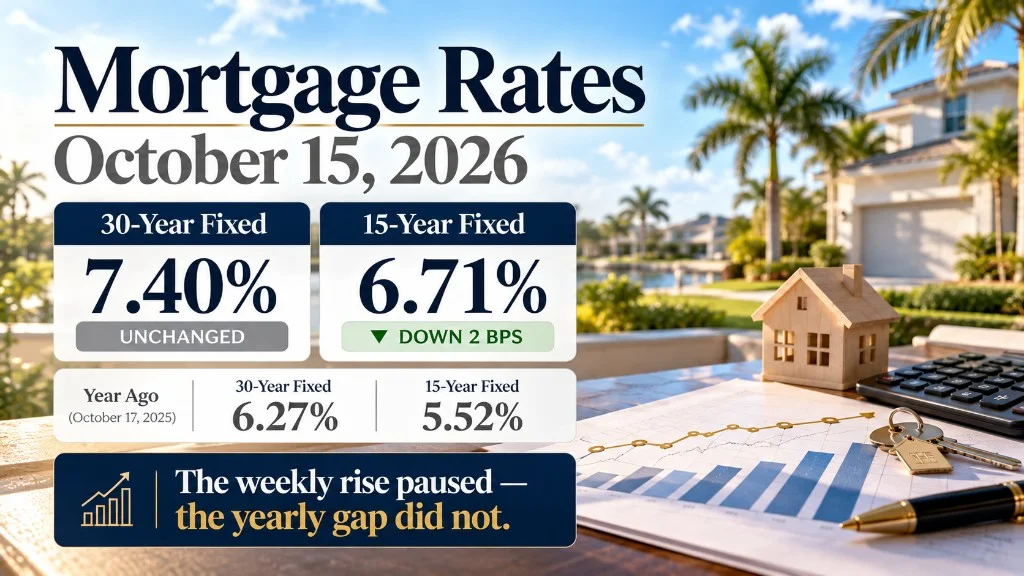
Freddie Mac's October 15, 2026 survey put the 30-year fixed at 7.40%, unchanged from October 8, and the 15-year fixed at 6.71%, down 2 basis points from 6.73%. A year ago the averages were 6.27% and 5.52%. On $300,000, principal and interest is $2,077.14 a month on the 30-year and $2,648.08 on the 15-year.

Freddie Mac's Primary Mortgage Market Survey dated October 15, 2026 put the 30-year fixed-rate mortgage at 7.40 percent, unchanged from the week before. The 15-year fixed averaged 6.71 percent, down 2 basis points from 6.73 percent on October 8. A year ago at this time, the 30-year averaged 6.27 percent and the 15-year averaged 5.52 percent. The 30-year is therefore 113 basis points above its year-ago week, and the 15-year is 119 basis points above its year-ago week. Freddie Mac released the survey on Thursday, October 15, at noon Eastern, and Chief Economist Sam Khater's line in the release was plain: the average 30-year fixed-rate mortgage remained unchanged this week.
A flat week at 7.40 percent is not a lower rate. It is the same rate, held for a second survey, after seven straight weekly rises carried the 30-year from the August 20 low of 6.65 percent to 7.40 percent on October 8. For a buyer who reran the numbers last week, the 30-year payment on the same loan has not moved. For a buyer still working from a September quote, nothing about this week repairs that gap. The pause matters because it ends the run of weekly increases on the Freddie Mac archive. It does not turn 7.40 percent into a cheap coupon, and it does not promise what the October 22 survey will print.
The survey covers conventional, conforming, fully amortizing home-purchase loans for borrowers who put 20 percent down and have excellent credit. Freddie Mac builds the average from thousands of loan applications submitted through Loan Product Advisor by lenders across the country. The application window for a Thursday survey runs from the prior Thursday through Wednesday. This is a national average for that borrower profile. It is not an APR, it is not a quote for a specific house in Citrus, Hernando, Pasco, Hillsborough, Pinellas, or Marion County, and it does not include taxes, insurance, association dues, mortgage insurance, or lender fees. A written quote from a lender, on a dated rate sheet, is the figure a contract can actually use.
The October 15 scoreboard
- 30-year fixed: 7.40% — unchanged from October 8 at 7.40%. A year ago: 6.27%.
- 15-year fixed: 6.71% — down 2 basis points from October 8 at 6.73%. A year ago: 5.52%.
- Gap between the two: 69 basis points this week, against 67 basis points on October 8. The gap widened by 2 basis points because the 15-year eased while the 30-year held.
- Year-over-year gap: the 30-year is 113 basis points above the year-ago week, and the 15-year is 119 basis points above the year-ago week.
The prior survey on this site is the October 8 Freddie Mac survey at 7.40 percent, which covered the seventh straight rise. This October 15 file is the next weekly survey in that same series, and the headline change is that the rise stopped for one week on the 30-year while the 15-year ticked down by 2 basis points. Two basis points is a small move. On the payment math below it is a few dollars a month, not a new price tier. Readers should keep the scale straight: unchanged on the loan most buyers use, a slight easing on the shorter loan, and both averages still more than a full percentage point above where they stood a year ago.
Eight weeks from the August low
Freddie Mac's 2026 archive prints this path for the 30-year fixed:
- August 20: 6.65%
- August 27: 6.66%
- September 3: 6.71%
- September 10: 6.76%
- September 17: 6.95%
- September 24: 7.03%
- October 1: 7.28%
- October 8: 7.40%
- October 15: 7.40%
From August 20 to October 8 the 30-year rose 75 basis points in seven straight weekly increases. October 15 breaks that streak by holding the line. A streak ending is information. It tells a buyer that the weekly average did not climb for an eighth week. It does not tell that buyer the average has started down, because a single flat week is not a decline. The 15-year, at 6.71 percent, did decline this week, by 2 basis points. That is the only downward move in this release, and it is on the product with the higher monthly payment and the faster principal paydown.
What the payment math says on $300,000
A payment is principal, term, and rate run through the standard fully amortizing formula: M = P × r(1 + r)^n ÷ ((1 + r)^n − 1), where r is the annual rate divided by 12 and n is the number of months — 360 for a 30-year loan and 180 for a 15-year loan. The figures below use only the printed Freddie Mac survey rates on $300,000 of principal. They leave out taxes, insurance, association dues, and mortgage insurance, and they are a lock only when a lender writes one.
- 30-year at 7.40% (October 15 and October 8): $2,077.14 a month in principal and interest. Unchanged from last week, because the rate is unchanged.
- 30-year at 7.28% (October 1): $2,052.64 a month. This week's average is $24.50 a month above the October 1 average on the same loan.
- 30-year at the year-ago 6.27%: $1,851.06 a month. This week's average is $226.08 a month above the year-ago average on the same $300,000, or $2,712.96 over twelve such payments.
- 15-year at 6.71% (October 15): $2,648.08 a month in principal and interest.
- 15-year at 6.73% (October 8): $2,651.40 a month. The 2-basis-point easing saves $3.32 a month, or $39.84 over twelve payments, on $300,000.
- 15-year at the year-ago 5.52%: $2,454.44 a month. This week's 15-year average is $193.64 a month above the year-ago average on the same loan.
Scaled to a round loan size, the year-over-year move on the 30-year is about $75.36 a month per $100,000 of principal. The one-week move on the 15-year is about $1.11 a month per $100,000. That contrast is the whole release in one line: the week was quiet, and the year was not. A buyer choosing between the two products is also choosing a payment shape. On $300,000, the 15-year at 6.71 percent costs $570.94 more each month than the 30-year at 7.40 percent, and it retires the debt in half the time with far less total interest. The lower rate does not make the shorter loan the lower payment. Households pick the term their monthly budget can actually carry, then check the total interest over the years they expect to hold the loan.
A $300,000 loan with 20 percent down corresponds to a $375,000 purchase price. That price is an illustration so the survey has a dollar figure attached to it, because Freddie Mac's surveyed borrower is the 20-percent-down profile. It is not a median price for any Florida county, and it should not be read as one. A buyer putting less down will carry a larger loan on the same house and may carry mortgage insurance on top of principal and interest. A buyer putting more down will carry a smaller loan. The survey rate is the starting coupon for the illustration. The actual note rate, points, and fees come from the lender's written quote.
How this sits next to construction, sales, and jobs
A mortgage survey does not count houses, and a construction release does not set a payment. September housing starts put starts at 1,221,000, single-family starts at 859,000, permits at 1,400,000, and completions at 1,192,000, down 14.0 percent from a year earlier. Those are units begun, authorized, and finished in a Census and HUD survey. The buyer standing in a builder's office brings this week's 7.40 percent survey average to that meeting as the financing backdrop, then reads the builder's own price, lot, and buydown terms on the contract. The earlier August housing starts briefing is the prior month of that same construction file, useful for the revision pattern and for nothing about today's coupon.
Resale pace is a separate clock. September consumer prices, Fed minutes, and existing-home sales put the existing-home sales pace at 3.99 million, with consumer prices up 0.6 percent in September and the federal funds target range at 3.75 to 4.00 percent after the September hike. Those September closings were financed at rates quoted weeks before this October 15 survey existed. A seller today is negotiating with buyers whose quotes are being written in the 7.40 percent survey environment, not in the environment that produced last month's closed sales. That timing gap is why a closed-sale comparable and a current payment quote have to be read together rather than substituted for each other.
Local work is a third clock. Florida September employment and unemployment put the state's seasonally adjusted unemployment rate at 4.4 percent, with Citrus County at 6.3 percent on the not-seasonally-adjusted county table and Marion County at 5.4 percent. A national mortgage average does not print a county jobless rate, and a county jobless rate does not print a mortgage coupon. A household in Dunnellon or Ocala lives in both files at once: the Marion labor market on the jobs page, and the national conforming average on this one. In Marion County, the Cala Hills, Ocala briefing walks the property-appraiser cards and the Tract J townhome file for one southwest Ocala neighborhood, which is the level at which a purchase actually happens — an address, a card, a tax district, and then a written quote.
Taxes are the part of the monthly cost this survey never touches. The Florida homestead property tax bill briefing works the millage math on an Ocala-district parcel and shows how the non-school and school lines behave under the proposed exemption. Principal and interest at 7.40 percent is one line of the monthly figure. The tax bill, the insurance premium, and any association dues are the other lines, and on a Florida house they can move independently of anything Freddie Mac publishes on a Thursday. An owner comparing a purchase against staying put should line all of those up on the same page before deciding that a flat survey week changed the answer.
For a buyer watching new construction specifically, Citrus County's own history sits in 2,102 permits and the school work plan, where Census counted 2,102 housing units authorized in Citrus County in the final annual 2025 permit file. That county-year count and this national weekly coupon answer different questions. The permit file tells you how much building the county authorized last year. This survey tells you what the average conforming purchase loan cost in the week ending October 15. Neither one tells you what a particular builder will ask for a finished house this weekend.
What buyers, sellers, and owners can use
For a buyer, the practical reading is narrow. If you were quoted against the October 8 survey, this week did not change the 30-year average underneath that quote. If your quote is older — from the October 1 survey at 7.28 percent or the September 24 survey at 7.03 percent — rerun the payment before you rely on it, because the average has moved $24.50 a month on a $300,000 30-year loan since October 1. Ask for any new quote in writing, with the rate, term, points, lender fees, and mortgage-insurance treatment on the page, and check how long the quote holds. Statewide context stays on Florida markets, and purchase work sits on residential.
For a seller, a flat week at the top of an eight-week climb is not a signal to reprice on the survey alone. Buyers financing today are underwriting at coupons roughly 113 basis points above the year-ago week, which is $226.08 a month more in principal and interest on a $300,000 30-year loan than the same loan carried a year ago. That is the financing environment your asking price has to meet, alongside condition, insurance, and comparable closed sales. A week in which the average stopped rising helps at the margin — no buyer this week has to absorb an eighth straight increase — but the level, not the one-week change, is what a monthly budget feels.
For an owner with a loan already closed, this survey does not rewrite your note. Its use is the next decision. A refinance has to beat your current coupon after closing costs, and an average of 7.40 percent will not beat a note written in a lower-rate year. A purchase of the next house, or a sale into this market, is priced against this survey environment and against your own tax and insurance lines. Owners watching the property-tax side of that ledger can start with the homestead millage math linked above and confirm their own parcel with the county property appraiser before treating any illustration as their bill.
What comes next on this tape
Freddie Mac publishes the next survey on Thursday, October 22, at noon Eastern. That survey will show whether the 30-year average resumes rising, holds at 7.40 percent for a third week, or eases. The Federal Open Market Committee meets October 27–28, with the statement scheduled for October 28. The funds rate is the overnight policy rate set by the Federal Reserve. The Freddie Mac average is the weekly rate on conforming purchase applications. The two are related through the broader bond market, and they are not the same number, so a hold or a move by the committee does not mechanically set the next Thursday print. This post takes no position on what either file will say. It records the survey that is actually out: 7.40 percent on the 30-year, 6.71 percent on the 15-year, for the week ending October 15, 2026.
The through-line for a Florida household is discipline about levels. The 30-year average is flat on the week and up 113 basis points on the year. The 15-year average is down 2 basis points on the week and up 119 basis points on the year. On $300,000, that is $2,077.14 a month on the 30-year and $2,648.08 a month on the 15-year, before taxes, insurance, and dues. A buyer who lines that payment up against a specific house, a dated written quote, and the tax and insurance lines for that address has everything this survey can honestly give them. The rest is the house.
Sources: Freddie Mac, Primary Mortgage Market Survey, week ending October 15, 2026, released October 15, 2026 at noon Eastern, including the survey page and the 2026 archive (30-year 7.40%, 15-year 6.71%; prior week 7.40% and 6.73%; year-ago 6.27% and 5.52%); Freddie Mac description of the survey as conventional, conforming, fully amortizing home-purchase loans for borrowers with 20 percent down and excellent credit, built from Loan Product Advisor applications. Payment figures are the standard fully amortizing calculation on the stated principal and printed survey rates and exclude taxes, insurance, association dues, and mortgage insurance.
For help reading a written quote against a specific house in Citrus, Hernando, Pasco, Hillsborough, Pinellas, or Marion County, contact Bridge Point Business & Real Estate Advisors at 352-515-0226 or request a consultation.
Questions people ask first
Quick answers to common questions about this topic.
What was the mortgage rate on October 15, 2026?
Freddie Mac's Primary Mortgage Market Survey dated October 15, 2026 put the 30-year fixed-rate mortgage at 7.40%, unchanged from October 8, and the 15-year fixed at 6.71%, down from 6.73%. A year ago the averages were 6.27% on the 30-year and 5.52% on the 15-year. The survey covers conventional, conforming, fully amortizing purchase loans for borrowers who put 20% down and have excellent credit.
Did mortgage rates fall in the October 15, 2026 survey?
The 30-year fixed did not fall. It held at 7.40% for a second week, ending seven straight weekly rises from the August 20 low of 6.65%. The 15-year fixed eased 2 basis points, from 6.73% to 6.71%. On $300,000, that 15-year easing is $3.32 a month in principal and interest.
What is the payment on a $300,000 loan at 7.40%?
Principal and interest on $300,000 for 30 years at 7.40% is $2,077.14 a month, using M = P × r(1 + r)^n ÷ ((1 + r)^n − 1) with r at the monthly rate and n at 360 months. At the year-ago average of 6.27% the same loan was $1,851.06 a month, a difference of $226.08. These figures exclude taxes, insurance, association dues, and mortgage insurance.
What is the payment on a $300,000 15-year loan at 6.71%?
Principal and interest on $300,000 for 15 years at 6.71% is $2,648.08 a month. At last week's 6.73% it was $2,651.40, so the 2-basis-point easing saves $3.32 a month. At the year-ago 15-year average of 5.52% it was $2,454.44 a month.
How does the October 15 survey compare with a year ago?
The 30-year average of 7.40% is 113 basis points above the year-ago 6.27%. The 15-year average of 6.71% is 119 basis points above the year-ago 5.52%. On $300,000, the year-over-year difference is $226.08 a month on the 30-year and $193.64 a month on the 15-year in principal and interest.
When is the next Freddie Mac survey and the next Fed meeting?
Freddie Mac publishes the next Primary Mortgage Market Survey on Thursday, October 22, 2026 at noon Eastern. The Federal Open Market Committee meets October 27–28, 2026, with the statement scheduled for October 28. Neither result is in the October 15 survey.
Talk with Bridge Point
Considering a purchase or sale in this market? Local guidance can make a meaningful difference.
Schedule a consultation
