
Market Update · 19 min read
Florida Appraisal Changes in 2026: The New UAD 3.6 Report
UAD 3.6 becomes the required format for new Fannie Mae and Freddie Mac appraisal submissions on November 2, 2026, with approved lender exceptions into mid-2027. FHA already allows optional UAD 3.6 submissions. The redesigned report changes how Florida buyers and sellers find value, condition, living area, and required repairs — not Florida property-tax law.

Florida homebuyers and sellers are entering a transition to Uniform Appraisal Dataset 3.6 — an updated appraisal data standard paired with a redesigned Uniform Residential Appraisal Report. The new report organizes property information in greater detail and changes how readers find condition, living area, comparable sales, and required repairs. November 2, 2026 remains the main Fannie Mae and Freddie Mac implementation date for new appraisals initially submitted to the Uniform Collateral Data Portal. Approved lender exceptions can extend part of the transition into mid-2027. FHA opened an optional broad-production window on October 1, 2026, and has not yet announced its own mandatory date.
For a buyer, the practical task is to understand the value conclusion and any conditions that affect financing. For a seller, it is to make the property's facts easy to verify. For both, the first question is the same: which appraisal format and loan-program requirements will this lender use for this property? The change is a national mortgage-reporting transition that reaches Florida through lenders and loan programs. Florida counties do not each pick a separate UAD launch date. State appraiser licensing remains a separate Florida Real Estate Appraisal Board matter. County property-tax assessment is another separate process.
A mortgage appraisal, a county tax assessment, a pricing analysis, and an automated home-value estimate serve different purposes. Evaluate the new mortgage report by its assignment, supporting evidence, and intended use — not by whether it looks longer than the last form you saw. Financing context for the same week sits on Freddie Mac's October 29 survey, which put the 30-year fixed at 7.24 percent. Policy context sits on the October 28 FOMC hold. Statewide markets stay on Florida. Purchase and sale work sits on residential. Lender-ordered valuation work sits on appraisal.
What is changing in Florida appraisals
Three abbreviations explain the change. The Uniform Appraisal Dataset, or UAD, standardizes the information reported electronically. The Uniform Residential Appraisal Report, or URAR, presents the appraisal in a form people can read. The Uniform Collateral Data Portal, or UCDP, is the submission system lenders use for appraisals associated with mortgages delivered to Fannie Mae and Freddie Mac. UAD 3.6 connects more detailed data with a redesigned report.
The new URAR is dynamic. Its sections expand to fit the property and assignment instead of forcing every relevant detail into a fixed form and a long general addendum. A condominium, a manufactured home, and a property with several residential units can therefore produce different-looking reports. There is no single page count that proves a report is complete.
Many underlying appraisal principles already existed. A new field does not automatically create a new valuation rule. The useful change for consumers is a clearer chain: what property was evaluated, what information was gathered, how it compares with competing properties, and what supports the final opinion. More pages or more fields do not, by themselves, establish that the value is right.
When the new appraisal report becomes required
The September 30, 2026 joint transition update is the schedule that matters now. Earlier summaries may show a different retirement date or suggest every lender must stop using the old report at once. The current schedule preserves the November mandate while allowing approved, temporary exceptions.
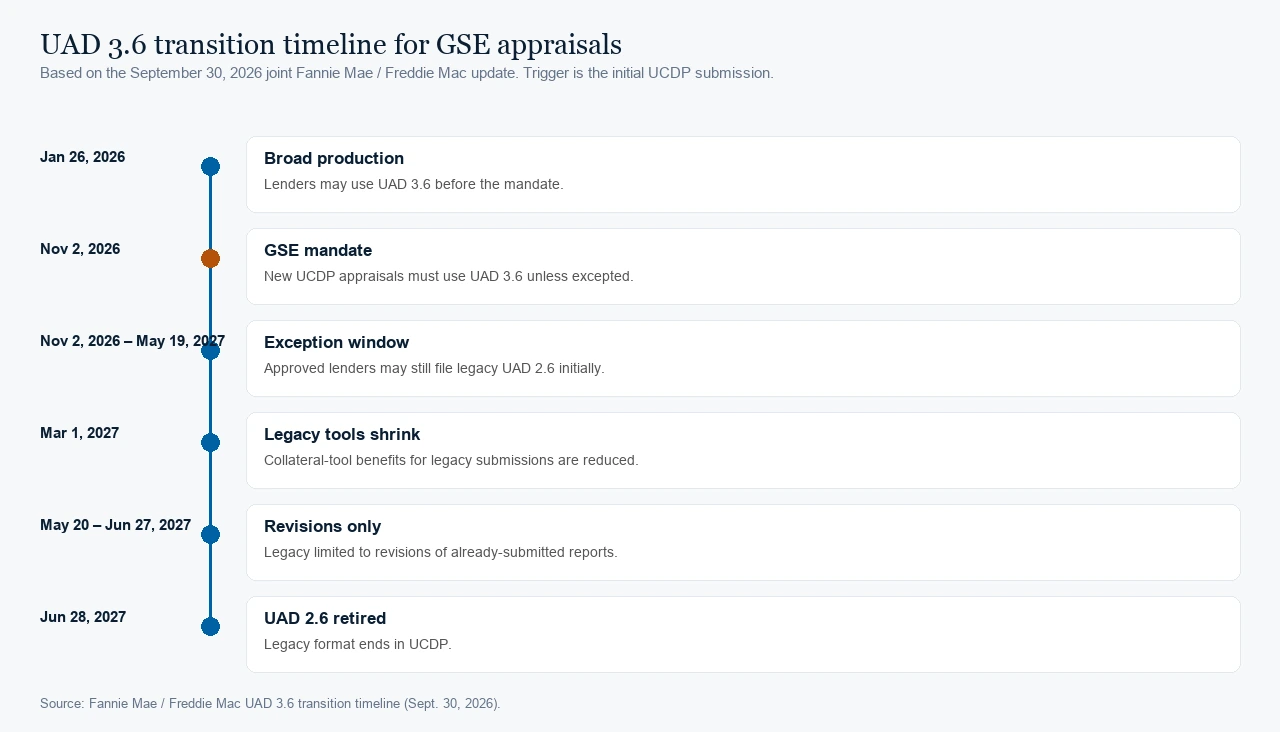
- January 26, 2026: Broad production began, allowing participating lenders to use UAD 3.6 before the mandate.
- November 2, 2026: UAD 3.6 becomes the required format for new appraisals initially submitted to UCDP, unless the submitting lender has an approved exception.
- November 2, 2026 through May 19, 2027: Approved exception holders may continue initial submissions of legacy UAD 2.6 reports.
- March 1, 2027: Certain lender collateral-tool benefits and functionality for legacy submissions are reduced during the exception period.
- May 20 through June 27, 2027: Legacy submissions are limited to revisions or resubmissions of reports already submitted; new initial submissions must use UAD 3.6.
- June 28, 2027: UAD 2.6 is retired in UCDP.
The triggering event is the initial UCDP submission, not the buyer's application date, the appraiser's inspection date, or the scheduled closing. An exception is lender-specific and must be approved. In these agency documents, "Seller" means an institution selling mortgage loans to the agency — not the homeowner selling the house.
Buyers should ask the lender which version applies, whether its appraisal provider is ready, and how any revision will be handled. Sellers should ask their agent to confirm the financing timetable early enough to accommodate access, document requests, and any required follow-up. An older-format report should not be rejected solely because someone has heard that November 2 makes every existing appraisal unusable.
FHA and other loan programs have their own schedules
FHA began an optional UAD 3.6 broad-production period on October 1, 2026. Its announcement allows continued legacy-format submissions and says FHA will announce its mandatory adoption date later. The initial format must remain consistent for subsequent submissions on the same FHA case.
Confirm the requirements for the actual loan program. Do not automatically apply the GSE deadline to an FHA, VA, or USDA transaction. The national mortgage-reporting mandate also does not automatically determine the format of a private appraisal for an estate, divorce, cash purchase, or commercial property. Land-only appraisals are outside the new URAR's scope.
How the new report differs from the legacy forms
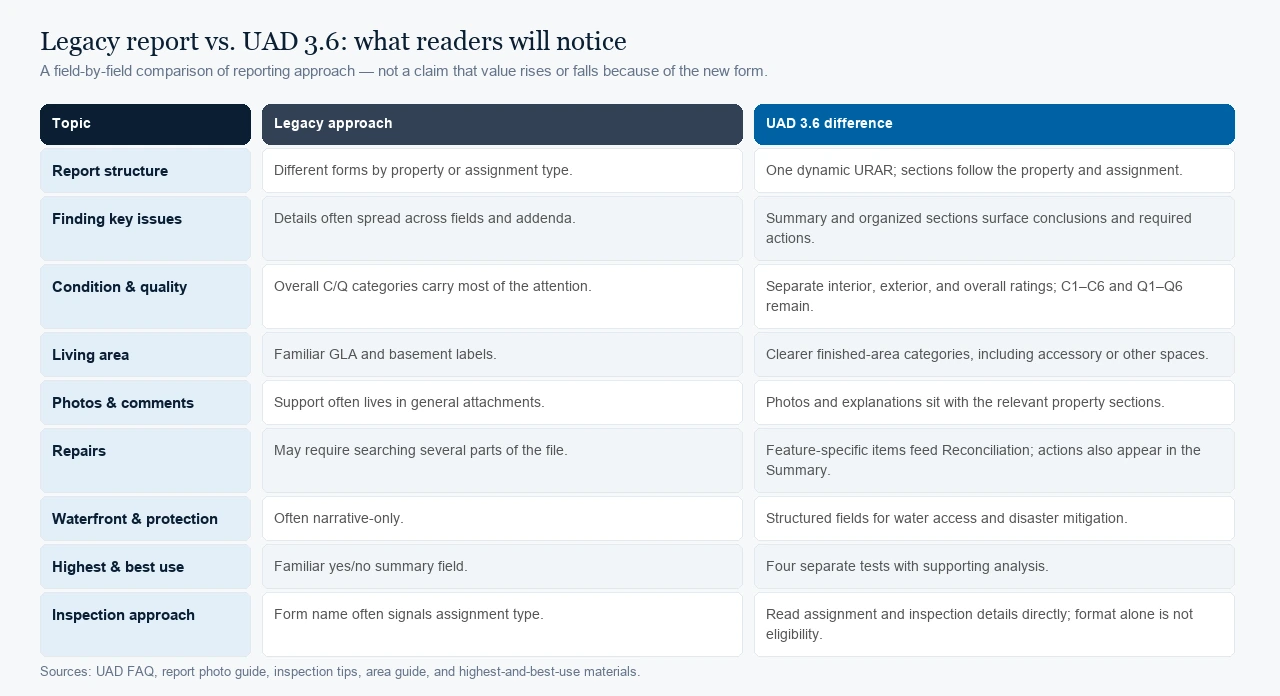
- Report structure: Legacy files used different forms for different property or assignment types. UAD 3.6 uses one dynamic URAR, with applicable sections determined by the property and assignment.
- Finding important issues: Information that used to sit across form fields and addenda is easier to locate through a Summary and more organized sections.
- Condition and quality: Overall categories still matter, and the familiar C1–C6 and Q1–Q6 scales remain. Separate interior, exterior, and overall ratings give more context.
- Living area: Finished-area categories are more explicit, with separate treatment of relevant accessory or other spaces.
- Photos, comments, repairs: Supporting material connects more directly to the relevant property sections. Feature-specific deficiency information feeds into Reconciliation, and required actions also appear in the Summary.
- Waterfront and protective features: Structured fields describe features such as water access and disaster mitigation instead of relying only on narrative.
- Highest and best use: Four separate tests and supporting analysis make the reasoning more visible than a single yes-or-no field.
- Inspection approach: Assignment and inspection information must be read directly. Format alone does not establish eligibility.

How to read the new appraisal report
Read by section name rather than by page number. This sequence is a practical review method, not a substitute for the appraiser's analysis or the lender's underwriting review.
Start with the Summary and the effective date
In the Summary, find the property identification, opinion of market value, and effective date of the appraisal. Check whether the conclusion addresses the property as it exists or assumes specified repairs, completion, or another condition. Items requiring action also appear in the Summary. Do not stop at the value number. A value that meets the contract price can still come with work that must be addressed. Write down each required action, who will determine that it has been satisfied, and when the lender needs that confirmation.
Check Assignment Information and Scope of Work
Identify the purpose, intended use, inspection information, and people involved in gathering property data. A traditional appraisal and a hybrid appraisal can involve different inspection arrangements. In a hybrid, a trained and vetted property data collector gathers information, and an appraiser develops the opinion of value. The collection itself is not the appraisal. A lender's value acceptance or appraisal waiver is a separate eligibility decision. UAD 3.6 does not mean every buyer will receive a waiver, every inspection will be remote, or an automated estimate will replace an appraiser.
Verify Subject Property and Site details
Check the address, unit identification, parcel information, property interest, lot characteristics, and access. For an unusual parcel, confirm which land and improvements are included. Site sections can carry waterfront characteristics and views. Direct frontage, a view, access rights, and a nearby public boat ramp describe different things. Flag factual inconsistencies with evidence — a survey, recorded document, permit record, or association document — rather than a general claim that the property "should be worth more."
Reconcile the Sketch and the area categories
Finished above-grade and below-grade areas are more explicit, with room for other applicable categories. Accessory dwelling units, outbuildings, and spaces that do not meet the relevant measurement criteria need careful treatment. ANSI measurement requirements did not begin with this transition, and requirements differ for some property types, including condominium apartments.
For a Florida home, pay particular attention to an enclosed lanai, converted garage, detached guest space, or area with unusual ceiling height. Do not assume every enclosed or air-conditioned space belongs in the same finished-area category. A separately reported area can still contribute value; separate classification is not the same as no market contribution. If the listing, tax record, and appraisal show different areas, compare measurement methods, dates, and definitions before asking the appraiser to adopt the largest available number.
Distinguish condition from construction quality
Condition describes physical state and maintenance. Quality describes design, materials, and workmanship. A carefully maintained basic house can be in good condition without being a high-end custom home. An expensive house can have serious deferred maintenance. The C1–C6 and Q1–Q6 scales remain, with clearer definitions. Ratings apply separately to dwelling exteriors, unit interiors, and the property overall. They follow absolute definitions rather than ranking a house against its neighbors. An existing property appraised subject to repairs or completion also receives an As Is Overall Condition Rating.
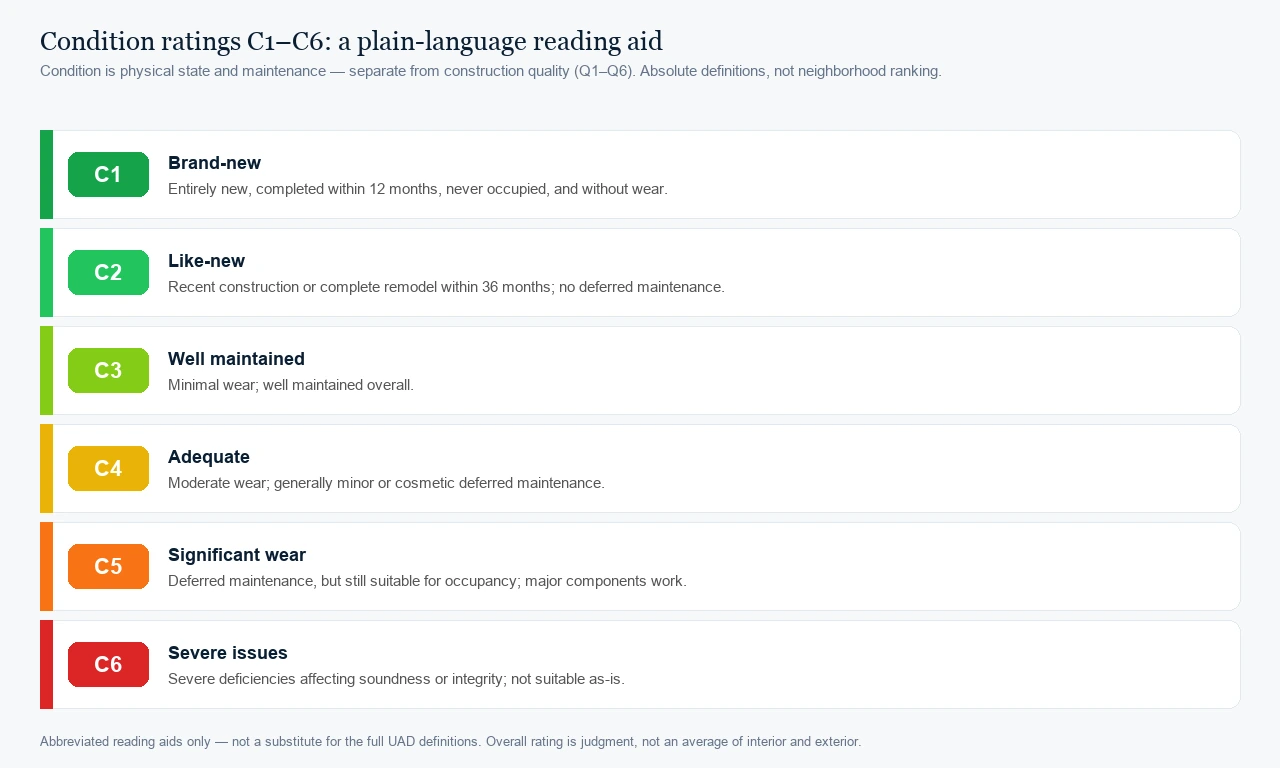
- C1: Entirely new, completed within 12 months, never occupied, and without wear.
- C2: Like-new recent construction or complete remodeling within 36 months, without deferred maintenance or needed repair.
- C3: Well maintained, with minimal wear.
- C4: Adequately maintained, with moderate wear and generally minor or cosmetic deferred maintenance.
- C5: Significant wear or deferred maintenance, while remaining suitable for occupancy and with major components functional.
- C6: Severe deficiencies affecting soundness or structural integrity; unsuitable for occupancy in its current condition.
These are abbreviated reading aids, not replacements for the full definitions. Quality ratings run from exceptional construction at Q1 to the lowest category at Q6. Q5 describes basic construction meeting minimum standards; it does not automatically mean substandard construction. An overall rating is a professional judgment, not the arithmetic average of interior and exterior numbers. Readers should not treat a category as an automatic percentage discount.
Review repairs and value conditions together
Find descriptions of damage, defects, and deficiencies in the relevant property sections. Reconciliation brings these issues together, and items requiring action also appear in the Summary. Check whether a statement describes an observation, requires a specialist inspection, or requires repair or completion. Those are different next steps. If the opinion assumes completed repairs, the present physical condition and the assumed completed condition are different concepts. Ask the lender what evidence of completion is acceptable and whether another visit is required.
Read highest and best use, market history, and comparables
The report separately addresses whether a use is legally permissible, physically possible, financially feasible, and maximally productive. A negative answer to one test requires attention to the explanation and relevant program rules; it is not a universal automatic loan denial. An appraisal checkbox does not grant zoning approval or establish that a short-term rental is allowed.
Review the described market area, the period analyzed, the listing history, the contract, and any relevant prior transfers. Market area is about competing properties and buyer behavior; it need not match a neighborhood label or county boundary. Ask why the selected properties compete with the subject. The closest, newest, or most expensive sale is not automatically the best comparable. Adjustments must be supported by market evidence, and improvement cost is not automatically recovered dollar for dollar. A seller's $45,000 renovation invoice documents expenditure. It does not, on its own, establish a $45,000 market-value increase.
Finish with Reconciliation and Revision History
Read how the appraiser weighs the evidence and arrives at the final conclusion. Reconciliation is not simply choosing the highest adjusted sale or averaging every figure. Confirm that you are reading the latest version. Make a short list of material questions, supported by documents where possible. Separate a factual correction from a disagreement about judgment. Send the list through the lender's designated process so the response becomes part of the transaction record.

What Florida buyers should expect
Ask three questions early: Which valuation option and format will be used? When should the report be available? What is the process if it identifies a repair, a factual error, or a value below the contract price? The answers help you plan the appraisal contingency, financing review, and closing discussions.
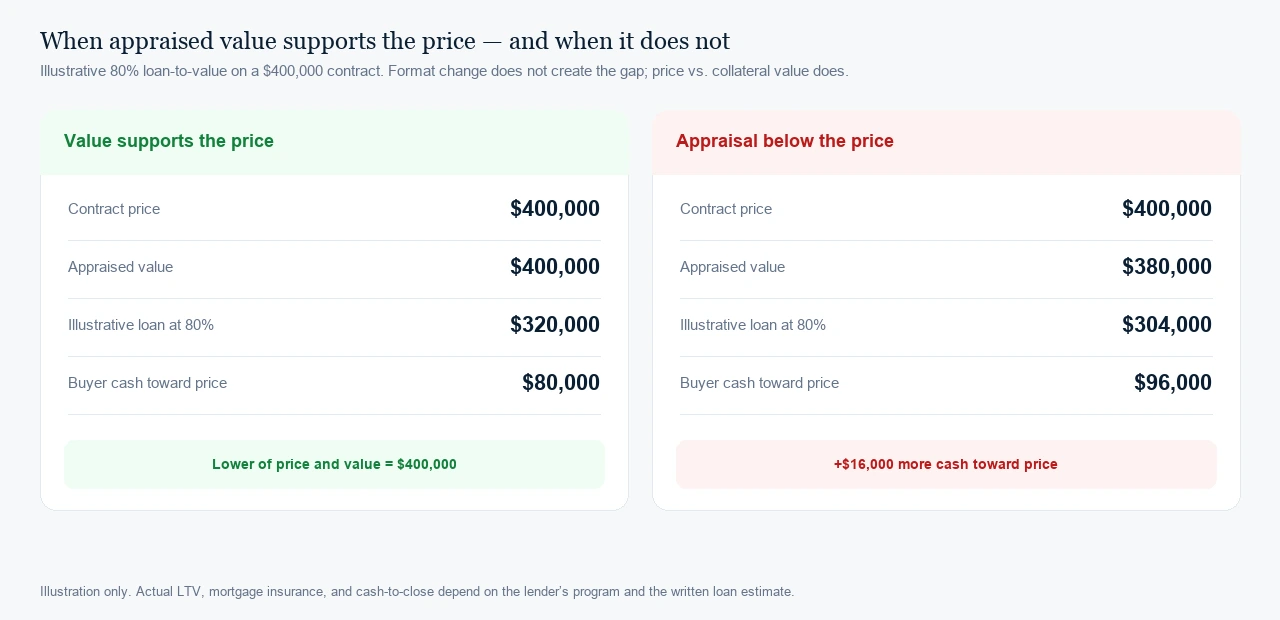
For a standard purchase calculation, Fannie Mae generally bases the loan-to-value ratio on the lower of the sales price and appraised value, subject to applicable exceptions. If a $400,000 contract is supported by a $400,000 appraisal and the lender limits the loan to 80 percent of that lower amount, the illustrative loan is $320,000 and the buyer's contribution toward the price is $80,000. If the appraisal comes in at $380,000, the same 80 percent illustration produces a $304,000 loan and a $96,000 buyer contribution — $16,000 more cash toward the price before closing costs and other terms. The change in report format did not create the value gap; the relationship between price, collateral value, and financing produced it.
For covered first-lien dwelling applications, federal Regulation B generally requires the creditor to provide copies of appraisals and other written valuations promptly upon completion or at least three business days before consummation, or account opening for open-end credit, whichever is earlier. Timing-waiver provisions apply. The copies must be free; where permitted by law, the creditor may require a reasonable fee to reimburse the cost of the appraisal or valuation itself. This borrower protection does not automatically give the seller the same entitlement.
If you identify an error or believe relevant evidence was overlooked, ask the lender about its reconsideration-of-value process before closing. Explain the issue, supply reliable support, and identify why a proposed comparable is relevant. Fannie Mae does not allow a borrower to submit an ROV request after the loan has closed. A reconsideration is a review process, not a guarantee that value will increase. Concerns about bias should also be raised through the available complaint and review channels.
What Florida sellers should do before the appraisal
Prepare a concise property packet with a dated improvement list, permits or final approvals that are available, relevant plans, association contacts, and documents describing unusual features. Identify unfinished work accurately. Distinguish a replaced roof from a repaired roof and a whole-home remodel from updates to selected rooms.
Provide access to the areas the assignment requires and tell the scheduling contact about access restrictions before the visit. If there is a detached building, tenant-occupied space, or locked utility area, coordinate entry through the appropriate parties. For waterfront property, organize records concerning docks, seawalls, or access rights where relevant. For solar equipment, identify ownership or financing arrangements. For a condominium, know who can provide current association and building information.
Present evidence without directing the appraiser toward a target result. An asking price, replacement cost, and recent improvement spending can provide context, but they do not substitute for market analysis. Accurate information and timely access are more useful than assumptions about whether an old or new form is inherently more favorable to the seller. Pricing discipline for a Florida listing still sits next to current comps and a current quote — including the October 29 Freddie survey and the separate Florida third-quarter condo briefing when the property is a condo or townhouse.
Florida property issues that deserve extra attention
Flood hazard, elevation-related features, and documented storm repairs should be reviewed for the specific parcel. A county name or coastal label alone is not an adequate property determination. A stated mitigation feature does not guarantee a value premium, an insurance discount, or lender acceptance.
A renovated condominium unit and the condition of its building are different subjects. The appraisal's property analysis and the lender's condominium-project review perform different functions. Where milestone-inspection, repair, or association records apply, obtain the relevant documents through the association and the correct local jurisdiction. An appraisal does not replace an engineering evaluation, a structural inspection, a reserve study, or a home inspection.
A detached guest house, converted garage, or separate living area may raise several questions at once: how it is measured, what use is allowed, whether it constitutes an accessory dwelling unit, and how buyers value it. Answer those questions separately. For new construction, compare the completed product, included features, and contract terms. A base model, a finished inventory home, and a resale with similar square footage can carry materially different features or concessions.
How the change may affect local Florida markets
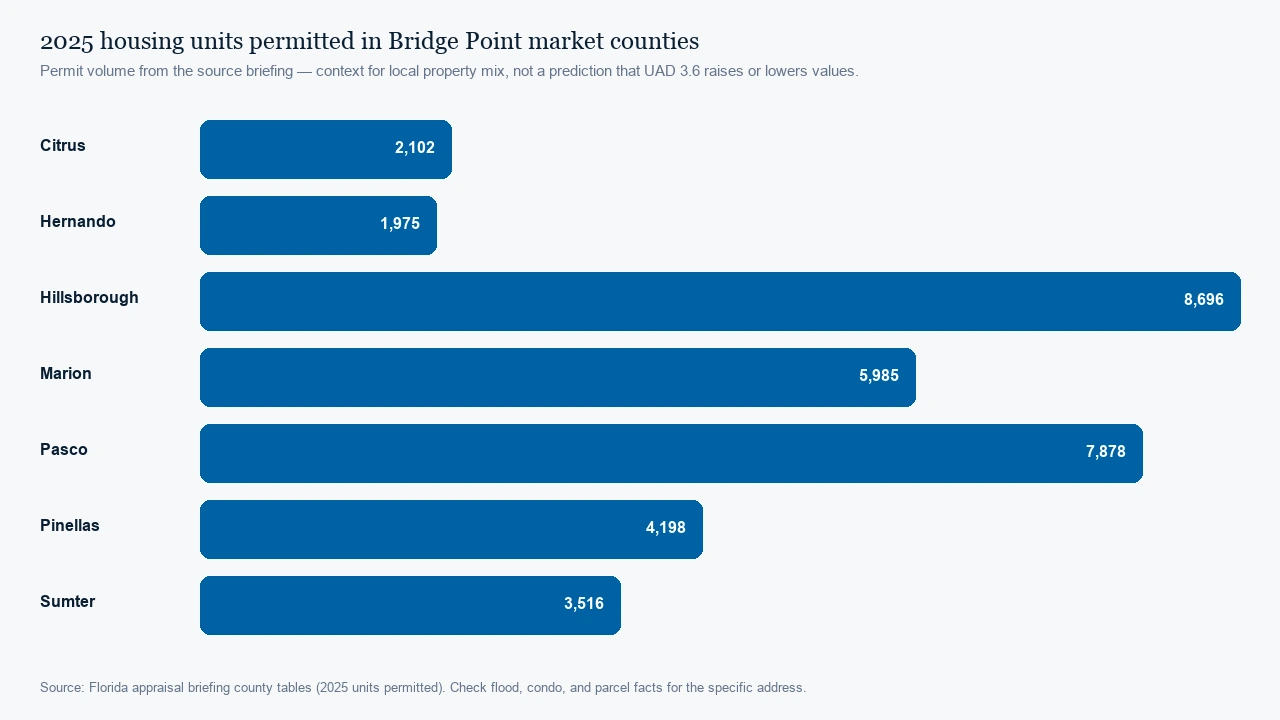
The transition is the same national reporting framework across Florida. Its practical effect varies with the property mix and the issues in an individual transaction. The notes below identify useful checks for markets Bridge Point works regularly — not predictions that values will rise or fall because of UAD 3.6.
- Hernando County: Confirm the applicable FEMA Flood Insurance Rate Map information for the parcel, including any map amendments, and reconcile it with the features and repairs described in the report. Local growth context sits on the Hernando ten-year growth briefing.
- Pasco County: Check whether any flood-map discussion is currently effective or proposed; those statuses are not interchangeable. For a new home, document included upgrades, construction status, and contract concessions so the appraisal reflects the actual purchase package.
- Pinellas County: For an applicable condominium, identify the building jurisdiction responsible for milestone-inspection records. Pinellas County's program covers unincorporated areas and specified municipalities, not every building in every city. Do not assume the unit's interior rating resolves the building review.
- Hillsborough County: Distinguish FEMA flood zones from county watershed floodplains. Watershed maps address rainfall-related flooding and do not model coastal storm surge. Identify which map is being used and for what purpose.
- Citrus County: Use county GIS resources for parcel, zoning, utility, permit, and flood information, then cross-check the current address and parcel with the responsible department when a map layer alone cannot answer the question.
- Marion County: For an acreage or equestrian property, document relevant use restrictions and improvements, then confirm the assignment's residential scope. A barn, residence, and operating agricultural business should not be assumed to represent a single interchangeable valuation problem.
- Sumter County: For a home in a community development district, identify the actual district and its charges. Bond assessments and ongoing maintenance assessments are different obligations; paying off the bond does not eliminate the maintenance obligation.
New-home supply and national price indexes remain separate files — including September new-home sales and August house prices. Federal housing-finance policy from the same month sits on the White House housing-costs order briefing. None of those tapes rewrites the appraisal format on a specific loan.
Does the new appraisal change Florida property taxes?
UAD 3.6 does not itself change Florida property-tax law, homestead rules, or assessment limits. A mortgage appraisal addresses its assignment and effective date. Florida's property-tax process generally values property as of January 1 and distinguishes just value, assessed value after applicable limits, and taxable value after exemptions. Buyers should estimate their own future tax circumstances instead of treating the seller's current bill as a reliable forecast. Sellers should avoid using a tax assessment as proof that a mortgage appraisal must reach the same number.
A practical preparation plan
- Before the appraisal is ordered: Confirm the loan program, expected report format, valuation approach, and communication process. Identify unusual property features and ask which documents should be supplied.
- Before the property visit or data collection: Organize relevant permits, plans, improvement dates, association contacts, and access arrangements. Clearly identify unfinished work and any known issue requiring specialist attention.
- When the report arrives: Read the Summary, property description, area categories, condition, comparable analysis, and Reconciliation together. Make a concise, evidence-based list of material questions.
- Before closing: Confirm how required actions will be satisfied, whether a revised report or completion documentation is needed, and whether the lender has accepted the final valuation materials. Keep the financing and contract timetable in view.
Bridge Point Business & Real Estate Advisors works purchase, sale, and appraisal files across Hernando, Citrus, Pasco, Hillsborough, Pinellas, and by assignment elsewhere in Florida. For help reading a redesigned appraisal against a specific house, call 352-515-0226 or request a consultation. Mortgage underwriting questions are routed to the lender; Bridge Point is a brokerage and appraisal firm, not a lender.
Sources: Fannie Mae and Freddie Mac Uniform Appraisal Dataset and forms redesign resources and updated UAD 3.6 transition timeline (September 30, 2026 schedule); Fannie Mae Lender Letter LL-2026-08; Freddie Mac UAD and forms redesign FAQ; HUD FHA INFO 2026-23 (October 1, 2026) on optional UAD 3.6 broad production; Florida DBPR Florida Real Estate Appraisal Board; Fannie Mae UAD 3.6 photo, inspection, condition/quality, ANSI, highest-and-best-use, hybrid, Selling Guide, and Selling Guide Supplement materials; CFPB Regulation B §1002.14; Florida Department of Revenue property-tax framework; county flood, GIS, milestone-inspection, and CDD resources for Hernando, Pasco, Pinellas, Hillsborough, Citrus, Marion, and Sumter. Research checked October 30, 2026. Transition dates and program policies should be rechecked before a later transaction.
Questions people ask first
Quick answers to common questions about this topic.
Is Florida introducing a completely different appraisal law in 2026?
The main change is the national UAD 3.6 mortgage-reporting transition. Florida appraiser licensing and county tax assessment remain separate systems. Local property characteristics affect the analysis, but counties do not independently select the national report's launch date.
Will every Florida appraisal use the new report on November 2, 2026?
No. The GSE mandate applies to new initial UCDP submissions, with approved lender exceptions that can continue legacy UAD 2.6 initial submissions through May 19, 2027. FHA announced its own optional transition on October 1, 2026, and other programs have separate requirements. Ask the lender which format applies to the specific loan and submission.
Will the new appraisal report make my Florida home worth less?
The format does not impose an automatic reduction. A property's value still depends on its characteristics, the assignment, and supported market analysis. More detailed reporting may expose a factual discrepancy or clarify a feature, but the outcome must be evaluated for the individual property.
Will an appraisal cost more or take longer under UAD 3.6?
There is no single fee or turnaround change established by the report format alone. Ask the lender or appraisal provider for a quote and expected timing based on the assignment, property complexity, access, and required follow-up.
Does a hybrid appraisal mean nobody evaluates the home?
No. In a hybrid appraisal, a trained and vetted collector gathers property data and an appraiser develops the value opinion. It remains an appraisal. A lender's value acceptance or waiver is a different option governed by its own eligibility criteria.
Can a converted garage or enclosed lanai still add value?
Possibly, but its reporting category, legal status, and market contribution require analysis. Space reported separately from the main finished area is not automatically worthless. Ask where the space appears in the report and what evidence supports its treatment.
Can I challenge a factual error or an unsupported conclusion in an appraisal?
Raise concerns promptly and ask the lender about its reconsideration-of-value process before closing. Provide specific facts, relevant documentation, and appropriately comparable sales if available. Fannie Mae's borrower-initiated ROV process does not accept requests after the loan closes. The process permits supported concerns to be reviewed; it does not promise a different value.
Is the new appraisal a substitute for a home inspection?
No. Read the stated scope of work and arrange the inspections or specialist reviews appropriate to the property. An appraisal's value opinion does not replace a comprehensive home inspection, engineering review, insurance assessment, or required condominium documentation.
Talk with Bridge Point
Considering a purchase or sale in this market? Local guidance can make a meaningful difference.
Schedule a consultation
