
Market Update · 14 min read
Banks Eased CRE Standards. Construction Demand Did Not Follow.
The Fed’s July SLOOS said banks eased standards on nonfarm nonresidential and multifamily loans in the second quarter. Construction and land-development demand weakened. The H.8 CRE book was $3.13 trillion in early September.

The official commercial-credit tape is not a 30-year mortgage survey. It is whether a bank will still do the building loan. The Federal Reserve’s July 2026 Senior Loan Officer Opinion Survey, released August 3 and covering the second quarter, said banks generally eased standards on commercial real estate loans and that demand was basically unchanged. The split inside that sentence is the file. Standards eased on loans secured by nonfarm nonresidential properties and, more modestly, by multifamily properties. Standards on construction and land-development loans stayed basically unchanged. Demand for those construction loans weakened.
The loan book itself is still growing. The Board’s H.8 release dated September 11, 2026 put commercial real estate loans at all commercial banks at $3,129.2 billion in August and $3,131.7 billion in the week ending September 2. August CRE loans grew at a 4.7% seasonally adjusted annual rate. That is outstanding bank credit. It is not a Tampa asking cap rate, and it is not a quote on a U.S. 19 strip.
This is a national commercial-credit briefing for Florida buyers, sellers, investors, and tenants. It sits next to the September 16 FOMC hike — that vote set the funds range at 3.75–4.00% and primary credit at 4.0%, effective September 17 — and the jobs, Beige Book, and CRE-volume briefing. A loan-officer survey does not set a Westshore rent. It can change who still clears a refinance or an acquisition loan on a building they already liked. For corridor process, keep the Pasco commercial overview and the Hillsborough commercial overview in the same reading list.
What the July SLOOS actually said
Fifty-six domestic banks and 18 U.S. branches and agencies of foreign banks answered between June 17 and July 2, 2026. Unless noted, the Board’s summary is the domestic-bank answers.
On commercial real estate, in the Committee’s words: a moderate net share of banks eased standards for loans secured by nonfarm nonresidential properties. A modest net share eased standards for multifamily. Construction and land-development standards remained basically unchanged on net. A moderate net share of foreign banks tightened CRE standards.
On demand: a moderate net share reported weaker demand for construction and land-development loans. Demand for nonfarm nonresidential and multifamily loans remained basically unchanged. Large banks — domestic assets of $100 billion or more as of March 31, 2026 — reported stronger demand for those standing-building loans. Other banks reported weaker demand for the same categories.

The same survey left C&I standards basically unchanged for firms of all sizes. Demand for C&I loans was stronger from large and middle-market firms — annual sales of $50 million or more — and basically unchanged from small firms. That is the operating-company cousin of the building loan. A stronger C&I bid can support an owner-user purchase. It does not reprice a vacant bay.
Standards eased. They are still tight versus the last twenty years.
The July SLOOS asked a special question it has used before: where are today’s standards relative to the midpoint of the range since 2005?
For CRE, a significant net share of banks said construction and land-development standards sit at the tighter end of that range. Moderate net shares said the same for nonfarm nonresidential and multifamily. Those tighter-end shares are lower than in the July 2025 survey. Easier than last summer is not the same as easy. The Board’s own glossary treats a net share of 0 to 5 percent as “basically unchanged,” 5 to 10 as “modest,” 10 to 20 as “moderate,” and 20 to 50 as “significant.”
Read that as a credit desk, not a slogan. A bank can ease a covenant or a spread and still decline the dirt deal, the empty office, or the land that only pencils if someone else builds the rooftops. Large banks eased standards on all CRE loan types in the second quarter. Other banks left multifamily and construction standards basically unchanged. If your lender is a community bank, do not borrow the large-bank sentence.
The H.8 book: $3.13 trillion, and most of it is already built
H.8 is the weekly and monthly balance-sheet tape. The September 11 release is the latest full print. The next Friday H.8, dated September 18, had not posted when this briefing was written. Use the printed week.
Seasonally adjusted, all commercial banks, billions of dollars:
- Commercial real estate loans, August 2025: $3,024.8
- August 2026: $3,129.2
- Week ending September 2, 2026: $3,131.7
Inside that September 2 week:
- Secured by nonfarm nonresidential properties: $1,909.3 billion
- Secured by multifamily properties: $640.1 billion
- Construction and land development: $459.0 billion
- Secured by farmland: $123.4 billion
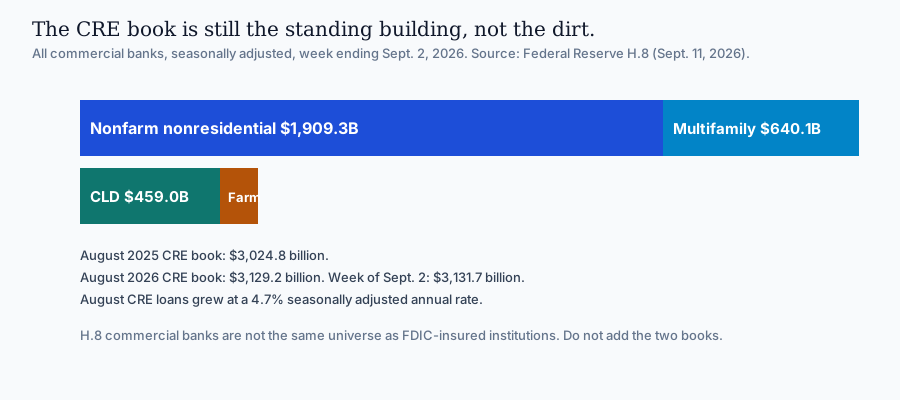
The standing-building lines grew. Nonfarm nonresidential was $1,833.6 billion in August 2025 and $1,909.5 billion in August 2026. Multifamily was $613.5 billion and then $638.6 billion. Construction and land development was $460.0 billion a year earlier and $457.9 billion in August 2026. That matches the SLOOS demand split: the dirt loan is the softer tape.
August CRE growth of 4.7% at an annual rate is the monthly pace, not a promise for the fourth quarter. July was 3.7%. June was 2.3%. The second-quarter annualized pace was 3.4%.
What FDIC said about the same buildings
The FDIC Quarterly Banking Profile for the second quarter of 2026 is a different universe: FDIC-insured institutions, not the H.8 commercial-bank panel. Do not add the two books.
On that insured-institution tape, nonfarm nonresidential loans were $1,943.2 billion, up 4.1% from the year-ago quarter and 1.0% from the first quarter. Construction and development loans were $453.5 billion, down 3.4% from a year earlier. Past-due and nonaccrual nonfarm nonresidential loans fell $2.4 billion, or 14 basis points, to a 1.52% PDNA rate. The industry’s overall PDNA rate was 1.44%. The quarterly net charge-off rate on real estate loans was 0.07%.
Community banks — the FDIC’s community-bank subset — held $598.3 billion of nonfarm nonresidential loans, up 2.3% from the year-ago quarter in the reported condition table. That is the Nature Coast and mid-Florida lender more often than a money-center desk. A cleaner PDNA line is not a green light to invent occupancy. It is a credit-quality print.
What Wednesday’s funds rate does to this file
The September 16 vote raised the federal funds target range to 3.75–4.00%. Interest on reserve balances is 3.90%. Primary credit is 4.0%. The new SEP median funds rate is 4.1% at the end of 2026 and the end of 2027. That is the cost of bank funds and the path the Committee wrote down. It is not a small-balance CRE quote, and it is not a 30-year residential survey.
SLOOS is a second-quarter credit-standards tape. The hike is a mid-September price-of-money tape. A bank can ease a standard in June and still reprice the same loan in the third week of September. Get a written term sheet dated after September 16. Do not underwrite a Pasco or Hillsborough building off a July loan-officer paragraph.
What it does to a Florida commercial file
For an owner-user buying a shop, medical bay, or small office: the standing-building loan is the SLOOS category that eased. Ask the lender, in writing, whether this file is a nonfarm nonresidential mortgage, a C&I loan secured by the building, or an SBA 7(a) or 504. Those are different machines. Verify current SBA rules. Process lives in the Pasco buying guide and Bridge Point’s buying commercial page. Do not invent a payment.
For an investor on retail, office, or industrial: easier standards are not a cap rate. H.8 says the book grew. SLOOS says large-bank demand for standing CRE was stronger and other-bank demand was weaker. Price the tenant you can defend. Westshore is an office-and-airport file. U.S. 19 is a west-Pasco retail and service file. Port and I-4 is industrial. They do not share a loan committee.
For a land or construction buyer: this is the tighter sentence. CLD standards were unchanged. CLD demand was weaker. H.8 construction and land-development balances are below August 2025. FDIC construction and development is down 3.4% year over year. Entitlement, utilities, access, and insurance still decide value more than acreage. Start with the questions in Pasco commercial land, then use the county that actually has the dirt.
For a seller: a national easing in standards can widen the buyer pool on a leased, insurable, access-honest building. It does not repair a vacant CLD site priced like a 2021 pad. Lead with rent roll, expense ledger, insurance, and the loan a buyer can actually close. The sequence is in the selling commercial property guide.
For a tenant: SLOOS is not a lease. C&I demand from larger firms was stronger. Small-firm C&I demand was unchanged. If you are deciding whether to lease or buy, keep leasing versus buying for the occupancy path and this article for the credit path.
Insurance and flood stay separate Florida constraints. A cleaner CRE PDNA rate does not reprice a coastal HO or a flood zone. Keep the Pasco flood and insurance guide next to the term sheet.
What it does not do
It does not set a vacancy rate. The Beige Book and broker surveys in the September 11 briefing are a different tape.
It does not set July or August commercial *sales* volume. MSCI/RCA is still that file, and official August volume was not the last print this desk used.
It does not invent a Florida median, a Wesley Chapel cap rate, or a Wiregrass rent. Those numbers are not in SLOOS, H.8, or the FDIC profile.
It does not replace a local lender conversation. Large banks and other banks answered the survey differently. Your term sheet is the only quote that counts.
The through-line
Banks eased standards on standing commercial real estate in the second quarter. They did not ease the construction tape, and they did not report stronger demand for dirt loans. The H.8 book is $3.13 trillion, mostly nonfarm nonresidential. FDIC past-due nonfarm nonresidential loans improved to 1.52%. Wednesday’s funds range is 3.75–4.00%. The useful question on a Hernando, Citrus, Pasco, Hillsborough, or Pinellas building is not “Did loan officers loosen in June?” It is “What written term sheet can this property clear after September 16?”
Bridge Point’s buying commercial and selling commercial pages are the service layer when you want that asked against a specific address.
What to watch next
- H.8 for the week after September 2: Board of Governors, Friday September 18 release, if posted.
- Next SLOOS: the October 2026 survey, covering the third quarter.
- FDIC Quarterly Banking Profile, 2026:Q3: late November, on the usual 55-day cadence.
- Next FOMC: October 27–28. That meeting does not include a new SEP. Minutes of the September 15–16 meeting are scheduled for October 7.
Sources: Board of Governors of the Federal Reserve System, Senior Loan Officer Opinion Survey on Bank Lending Practices (July 2026, released August 3, 2026), including the public summary and chart data for commercial real estate; Board of Governors, H.8 Assets and Liabilities of Commercial Banks in the United States (September 11, 2026), Tables 1 and 2; FDIC Quarterly Banking Profile, Second Quarter 2026, and accompanying charts; FOMC statement and implementation note (September 16, 2026).
For help reading this against a specific building, pad, or lease in Hernando, Citrus, Pasco, Hillsborough, or Pinellas County, contact Bridge Point Business & Real Estate Advisors at 352-515-0226 or request a consultation.
Questions people ask first
Quick answers to common questions about this topic.
Did banks ease commercial real estate lending standards in 2026?
In the second quarter, yes on standing buildings, on net. The Fed’s July 2026 SLOOS said a moderate net share of banks eased standards on nonfarm nonresidential loans and a modest net share eased standards on multifamily loans. Construction and land-development standards were basically unchanged. Foreign banks tightened CRE standards on net.
Is construction financing easier too?
Not on this survey. Construction and land-development standards were basically unchanged, and a moderate net share of banks reported weaker demand for those loans. H.8 construction and land-development balances in August 2026 were below August 2025. FDIC construction and development loans were down 3.4% year over year in the second quarter.
How large are bank commercial real estate loans right now?
The Federal Reserve’s H.8 dated September 11, 2026 put CRE loans at all commercial banks at $3,129.2 billion in August and $3,131.7 billion in the week ending September 2. Most of that is nonfarm nonresidential ($1,909.3 billion that week), then multifamily ($640.1 billion), then construction and land development ($459.0 billion).
Why don’t the Fed H.8 and FDIC numbers match?
They are different universes. H.8 covers commercial banks on the Board’s weekly balance-sheet release. The FDIC Quarterly Banking Profile covers FDIC-insured institutions. The FDIC second-quarter nonfarm nonresidential total was $1,943.2 billion. Do not add the two books or treat one as a correction of the other.
Did commercial loan quality get worse?
Not on the FDIC second-quarter print. Past-due and nonaccrual nonfarm nonresidential loans fell $2.4 billion, or 14 basis points, to 1.52%. The industry PDNA rate was 1.44%. The quarterly net charge-off rate on real estate loans was 0.07%. That is credit quality, not occupancy.
Does the September 16 Fed hike cancel the SLOOS easing?
They are different tapes. SLOOS describes second-quarter standards and demand. The September 16 vote set the funds range at 3.75–4.00% and primary credit at 4.0%, effective September 17. A bank can ease a standard in June and still reprice the loan in September. Get a written term sheet dated after September 16.
Does this set a cap rate or rent for a Florida building?
No. SLOOS, H.8, and the FDIC profile do not publish Tampa Bay cap rates, vacancy, or asking rents. Do not invent them. Underwrite the specific property, the tenant, insurance, and a current lender quote.
What should a Florida commercial buyer or seller do with this?
Treat standing-building credit as incrementally more available than a year ago at large banks, and treat construction and land as the tighter file. Ask which loan box the lender is using. Price a listing to the buyer who can close. Insurance and flood remain separate Florida constraints.
Who can help apply this to a Florida commercial property?
Bridge Point Business & Real Estate Advisors advises commercial buyers, sellers, investors, and tenants across Hernando, Citrus, Pasco, Hillsborough, and Pinellas. Call 352-515-0226 or request a consultation. Your lender, not the advisor, issues the term sheet.
Talk with Bridge Point
Considering a purchase or sale in this market? Local guidance can make a meaningful difference.
Schedule a consultation
