
Ages 40–49 Now File 26.8% of New Bankruptcies. The Count Is Still Not 2015.
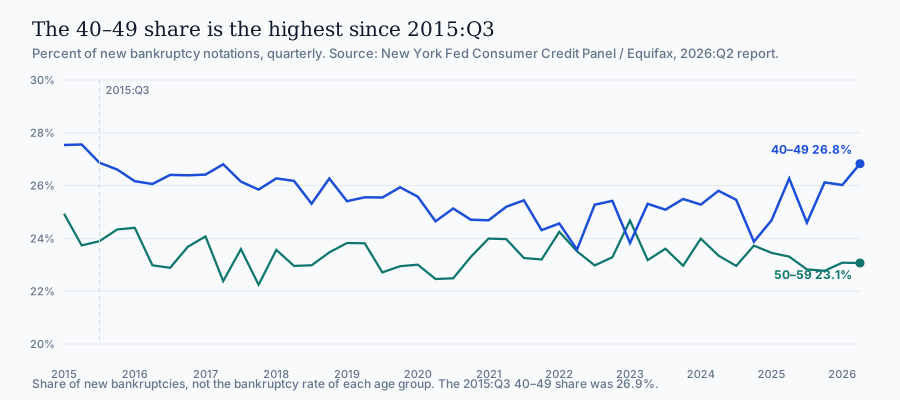
The New York Fed’s 2026:Q2 credit panel put ages 40–49 at 26.8% of new bankruptcy notations — the highest share since 2015:Q3. Ages 50–59 added 23.1%. About 137,000 consumers. The filing count is still about half of 2015.

The New York Fed’s second-quarter credit report is out. Ages 40–49 now account for 26.8% of new consumer bankruptcy notations — the highest share since the third quarter of 2015, and the largest of any age group. Ages 50–59 are 23.1%. Together, people 40 to 59 are 49.9% of those new notations. About 137,000 consumers. In the second quarter of 2015 it was 265,000.
Those shares come from the Federal Reserve Bank of New York’s Quarterly Report on Household Debt and Credit for the second quarter of 2026, released in August. The report uses the New York Fed Consumer Credit Panel / Equifax, a nationally representative sample of credit reports. A “new bankruptcy” is a notation first reported in the prior three months, from lender account records and public records. Age is the current year minus the birth year. Files with no birth year are left out of the age shares.
This is a national credit briefing for Florida buyers and sellers. Read it with the FOMC-eve rate briefing, the August CPI report, the Freddie Mac 6.76% survey, and the jobs, Beige Book, and foreclosure briefing. Who is filing bankruptcy does not set a South Tampa list price. It can change who still qualifies on a house they already liked. For local process, use the Florida home buying guide and the Pasco, Hillsborough, and Pinellas overviews.
What the New York Fed reported
The report publishes a national count and a separate age breakdown. They are close, not identical.
About 137,000 consumers had a new bankruptcy notation added to a credit report in the second quarter of 2026 (the table is 136,800). That is up from 124,020 in the first quarter and 131,320 a year earlier. It is well below 234,280 in the second quarter of 2019 and 265,300 in the second quarter of 2015. About 55,160 consumers had a new foreclosure notation in the same quarter, versus 52,800 a year earlier.
By age, in thousands: 8.00 ages 18–29, 29.36 ages 30–39, 36.66 ages 40–49, 31.52 ages 50–59, 19.92 ages 60–69, and 11.18 ages 70+. Those six groups add to 136,640. The small gap versus the national count is people with no birth year on the file.
Shares of that 136,640, rounded to one decimal:
- 18–29: 5.9%
- 30–39: 21.5%
- 40–49: 26.8%
- 50–59: 23.1%
- 60–69: 14.6%
- 70+: 8.2%
- 40–59 combined: 49.9%
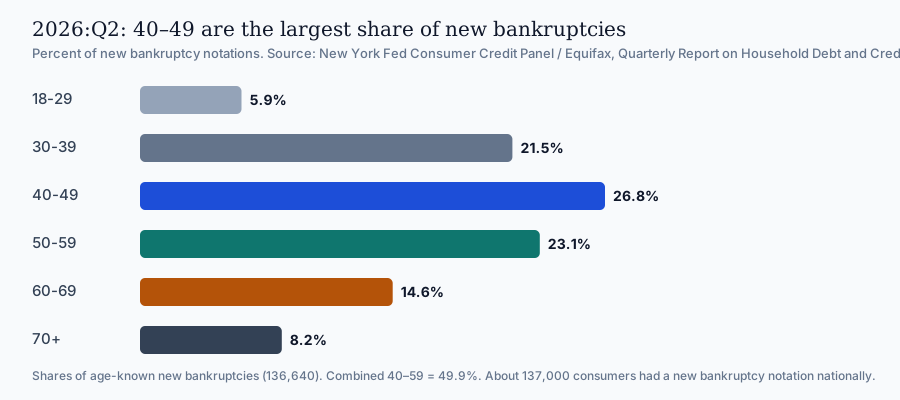
Ages 40–49 are the largest group. That has been true in almost every quarter since 2014. What changed is the size of their slice. At 26.8%, the second quarter of 2026 is the highest 40–49 share since the third quarter of 2015 (26.9%). The second quarter of 2017 came close and did not pass it. Combined, ages 40–59 at 49.9% is the highest reading since the first quarter of 2017.
A share is not a rate, and 137,000 is not 2015
If 26.8% of new bankruptcies are ages 40–49, that means 26.8% of the people who received a new bankruptcy notation this quarter were in that age band. It does not mean 26.8% of 40-to-49-year-olds filed. This report does not publish a bankruptcy rate by age.
The raw count is the other half. About 137,000 new notations in the second quarter is +10% from the first quarter and +4% from a year earlier. It is still 42% below the second quarter of 2019 and 48% below the second quarter of 2015. Adding the four quarters in the age table: about 501,000 in 2025 versus 957,000 in 2015. The share can look like 2015. The volume does not.
The rest of the same report is not 2008 either. Total household debt ended June at $18.77 trillion, down $13 billion (0.1%) on the quarter. Mortgage balances on credit reports were $13.12 trillion. The New York Fed says most of the $74 billion quarterly decline was a gap in how servicers reported loans, not a paydown. Home-equity lines rose $13 billion to $459 billion, the 17th straight quarterly increase. Auto loans $1.71 trillion. Credit cards $1.26 trillion. Student loans $1.65 trillion. 4.7% of outstanding debt was in some stage of delinquency. Balances 90 or more days late: 0.99% of mortgages, 5.49% of auto loans, 12.92% of credit cards, and 10.6% of student loans.
Court filings are a separate count
The Administrative Office of the U.S. Courts counts cases filed, not notations on a credit report. Those are two official series. Do not treat 137,000 and the court total as the same number.
For the 12 months ending June 30, 2026, Table F-2 shows 608,511 bankruptcy cases. 581,570 were nonbusiness — the court’s consumer-heavy category. Chapter 7: 382,161. Chapter 13: 215,490. A year earlier: 542,529 total and 519,486 nonbusiness. That is +12.2% for all cases and +12.0% for nonbusiness.
In the three months ending June 30, 2026: 162,772 cases, 155,807 nonbusiness. The prior quarter: 152,262 and 145,361. Court filings rose in the June quarter the same way the credit-report count did. That is a 2024–2026 climb, not a 2010 wave.
What the Florida numbers show
The New York Fed does not break bankruptcies down by age inside Florida.
It does publish, for selected states, the share of consumers with a credit report who received a new bankruptcy notation. In the second quarter of 2026 that was 0.052% in Florida and 0.046% in the United States. A year earlier: 0.047% in Florida and 0.045% nationally. Florida is slightly above the national figure. Nevada was 0.087%. New York was 0.028%.
The court count is the state total. Adding Florida’s three districts on Table F-2 for the 12 months ending June 30, 2026:
- Northern District of Florida: 2,827 total, 2,676 nonbusiness
- Middle District of Florida: 29,567 total, 28,090 nonbusiness
- Southern District of Florida: 16,944 total, 15,935 nonbusiness
- Florida total: 49,338 cases, 46,701 nonbusiness
A year earlier: 40,679 total and 38,536 nonbusiness. Florida nonbusiness filings are +21.2% year over year — faster than the national +12.0%. Florida was 8.0% of U.S. nonbusiness filings in that 12-month window. In the June quarter alone the three districts opened 13,653 cases (12,935 nonbusiness).
Florida’s consumer cases are more often Chapter 7 than the nation’s. Of those 46,701 nonbusiness cases, 33,130 were Chapter 7 (70.9%) and 13,501 were Chapter 13. Nationally, nonbusiness Chapter 7 was 63.1%. Chapter 7 is a liquidation case. Chapter 13 is a repayment plan. The table does not say why Florida’s mix is heavier on Chapter 7, and it does not give a county sale price.
Foreclosure is a different event. ATTOM’s July 2026 report, already in the jobs and foreclosure briefing, put Florida’s July filing rate third among states — 4,596 filings, 1 in 2,232 housing units. Bankruptcy and foreclosure can show up in the same household. They are not the same filing.
Why this matters for housing
The same report that splits bankruptcies by age also splits balances by age. Ages 40–49 hold $3.60 trillion of mortgage debt — the most of any group. Ages 50–59 hold $2.98 trillion. Together those two bands are $6.58 trillion, about 50% of the $13.12 trillion mortgage book. They also hold the largest credit-card balances ($295 billion and $280 billion) and the largest auto balances ($409 billion and $351 billion).
The age groups that now account for half of new bankruptcies already hold about half of U.S. mortgage debt. A new bankruptcy notation shows up on a credit report. Lenders will see it. It does not change the list price. It can keep that household out of a conventional, FHA, or VA loan for years, depending on the chapter and the lender’s rules. VantageScore 4.0 can use rent history. It cannot erase a bankruptcy.
Mortgage rates and insurance are the other half of the same story. Freddie Mac’s 30-year was 6.76% for the week ending September 10. The 10-year Treasury closed September 10 at 4.95%. August CPI shelter was +0.3% on the month and +3.0% over the year. None of those figures is a bankruptcy filing. Together they help explain why a 40-to-59-year-old with a 2021 payment, a 2026 insurance bill, and a home-equity line that has risen for 17 quarters can end up in this file.
What it does to housing
For a buyer, this report is not a reason to wait for prices to crack. Distressed sales were 2% of NAR’s August existing-home closings. August existing-home sales were 3.98 million. Get a written lock quote and a current credit pull. If a bankruptcy is already on the report, ask the lender which chapter, which discharge or dismissal date, and which waiting period applies to this product — conventional, FHA, or VA. A generic waiting-period chart is not your answer.
For a first-time buyer under 40, the 18–29 share is 5.9% and the 30–39 share is 21.5%. Younger households are not the center of this report. Payment, insurance, and credit score still are. Keep the VantageScore 4.0 rent-score guide on the credit side and the Freddie Mac 6.76% briefing on the rate side.
For a seller, 137,000 new bankruptcy notations is not a wave of distressed listings. It is a thinner qualified-buyer pool in the age groups that hold the most mortgage debt. Price against current comps and current lock quotes. The pricing strategy guide is the local process. A bankruptcy on a neighbor’s credit report does not cut your homeowners premium.
Insurance and flood stay separate Florida constraints. A 26.8% age share does not reprice a roof or a flood zone. Keep the Pasco flood and insurance guide next to the credit conversation.
Local streets still need their own guides: South Tampa and Hyde Park, FishHawk and Lithia, Apollo Beach and Ruskin, Wesley Chapel, Dunedin.
What it does to commercial real estate
Consumer Chapter 7 and Chapter 13 cases are household events. They are not a Tampa cap rate. They can show up as a missed retail or garden-style rent, a thinner purchase pool for a user-occupied building, or a personal guarantee that is no longer a guarantee.
The same 40–59 group that accounts for half of new bankruptcies is also the small-business ownership band on a lot of U.S. 19 and SR 54 corridors. A rising consumer-bankruptcy share is a tenant-credit caution, not a listing instruction. Keep corridor work in the Pasco commercial overview and the Hillsborough commercial overview.
The through-line
The New York Fed’s second-quarter report says ages 40–49 are 26.8% of new bankruptcy notations, the highest share since the third quarter of 2015. Ages 50–59 are 23.1%. Combined, 49.9%. About 137,000 consumers. Those same two groups hold about half of U.S. mortgage debt. U.S. Courts counted 581,570 nonbusiness filings in the year ending June 30, +12% from a year earlier. Florida’s three districts were 46,701 nonbusiness, +21%. The share looks like late 2015. The count does not. The useful question in Hernando, Citrus, Pasco, Hillsborough, or Pinellas is whether this buyer still clears the payment, the insurance, and the credit box on a quote you can hold.
Bridge Point’s residential buying and home selling pages are where that gets asked against a specific property.
What to watch next
- FOMC statement, implementation note, and economic projections: September 16, 2:00 p.m. ET. That is a rate decision, not a bankruptcy report. See the eve briefing.
- Next New York Fed Quarterly Report on Household Debt and Credit: third quarter of 2026. That is the next official age breakdown.
- Next U.S. Courts Table F-2: 12 months and quarter ending September 30, 2026.
- Next Freddie Mac weekly survey: September 17.
Sources: Federal Reserve Bank of New York, Quarterly Report on Household Debt and Credit, 2026:Q2 (released August 2026), including page 3 (balances), page 12 (90+ delinquency), page 17 (new foreclosure and bankruptcy notations), page 21 (debt by age), page 30 (new bankruptcies by age), and page 40 (new-bankruptcy rate by selected state), New York Fed Consumer Credit Panel / Equifax; New York Fed press release, August 11, 2026; Administrative Office of the U.S. Courts, Table F-2 (12 months ending June 30, 2026, and June 30, 2025) and Table F-2 Quarterly (three months ending June 30, 2026, and March 31, 2026); Freddie Mac PMMS via FRED MORTGAGE30US (week ending Sept. 10, 2026); Board of Governors H.15 via FRED DGS10 (Sept. 10, 2026); BLS Consumer Price Index — August 2026 (USDL-26-1496); NAR Existing-Home Sales (August 2026); ATTOM July 2026 Foreclosure Market Report, as cited in the September 11 briefing.
For help reading this against a specific house or building in Hernando, Citrus, Pasco, Hillsborough, or Pinellas County, contact Bridge Point Business & Real Estate Advisors at 352-515-0226 or request a consultation.
Frequently Asked Questions
Quick answers to common questions about this topic.
Talk with Bridge Point
Considering a purchase or sale in this market? Local guidance can make a meaningful difference.
Schedule a Consultation
